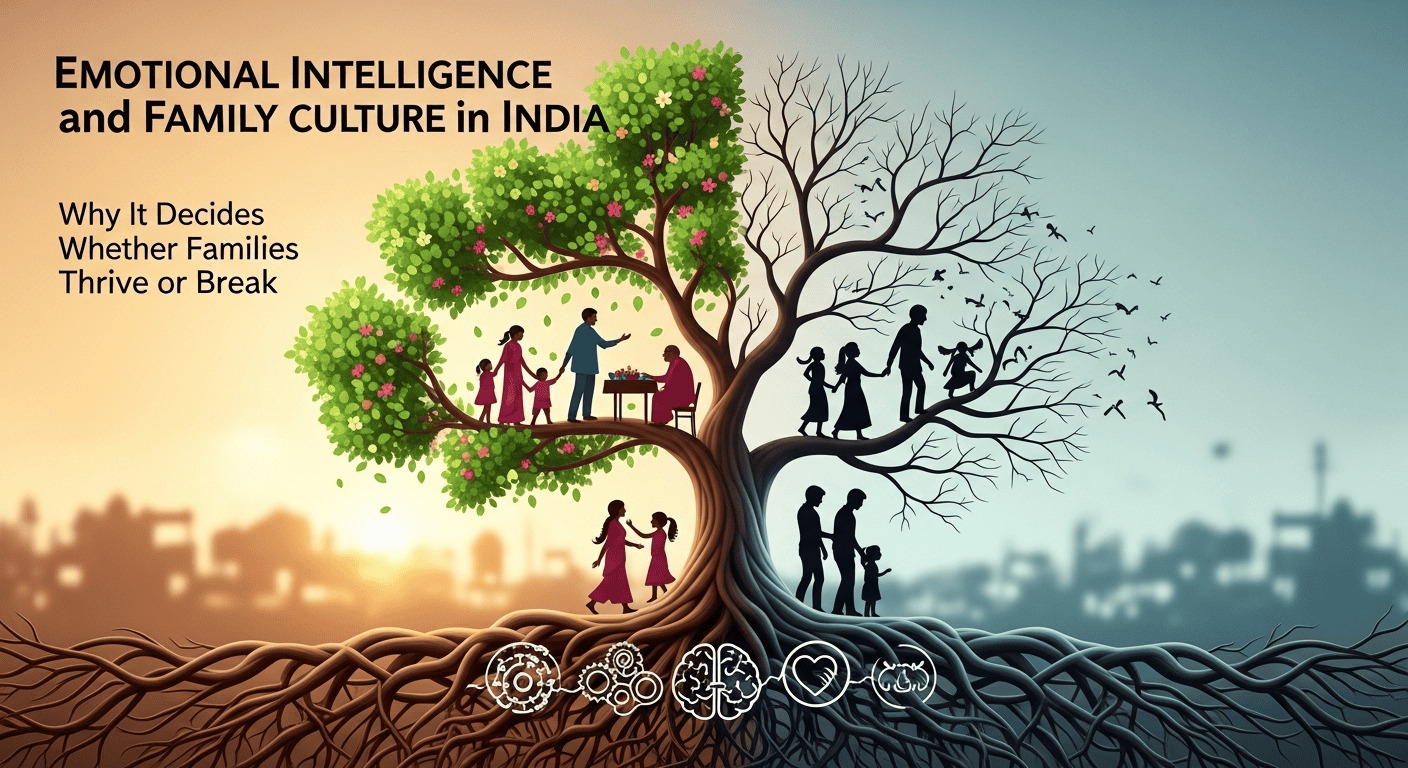
Why It Decides Whether Families Thrive or Break
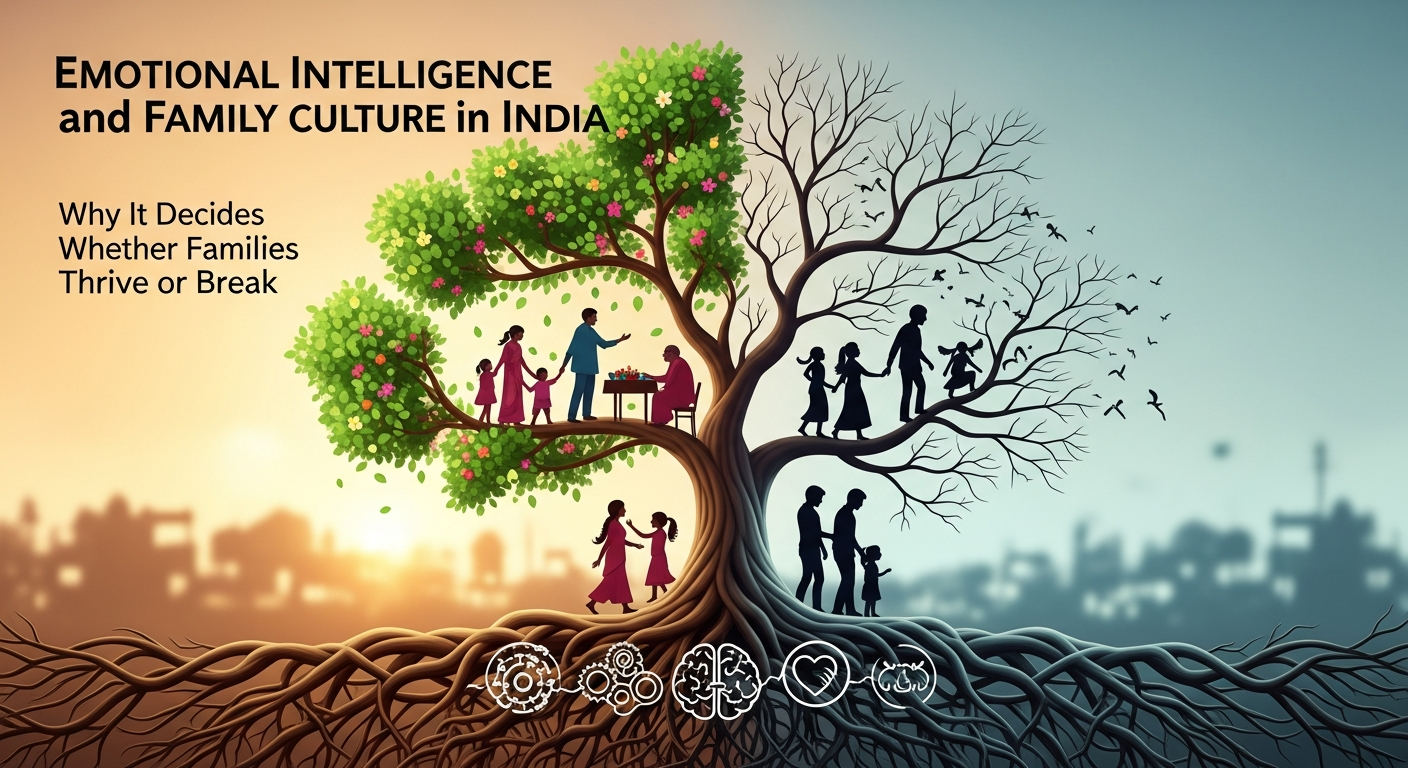
The Moment That Broke Ramesh’s Heart (Though No One Saw It)
When Ramesh heard the bedroom door slam again, he didn’t get angry.
He didn’t shout.
He didn’t chase after his son.
He simply sat on the sofa, quietly staring at the wall, asking himself a question that haunts many Indian fathers:
“When did my child stop talking to me?”
The boy didn’t hate him.
He wasn’t rebellious.
He wasn’t disrespectful.
He was distant.
A distance that was subtle at first, then normal, then permanent.
And Ramesh realised something painful:
They lived under the same roof, but not in the same emotional world.
It wasn’t lack of love.
It was lack of emotional connection.
And that difference is what decides whether Indian families thrive or quietly break.
1. The Emotional Operating System of Indian Homes
Every family runs on an invisible emotional operating system.
It governs:
how people speak
how conflicts escalate
how affection is expressed
how mistakes are handled
how children feel safe, or scared
how parents respond to emotional overwhelm
In India, this operating system was built generations before us.
We didn’t design it.
We inherited it.
And that inheritance carries repeating patterns:
fathers stay silent
mothers absorb everything
children remain confused
families function, but don’t emotionally flourish
This isn’t because Indian families lack love.
It’s because they lack emotional literacy — the ability to understand, express, and regulate emotions in healthy ways.
2. The Generational Story We Never Questioned
Take any Indian home, and you’ll see the past living inside the present.
Our grandfathers believed
“Strength means silence.”
They lived in survival mode.
Emotions were luxuries.
Our fathers believed
“Sacrifice keeps the family together.”
They carried responsibility like a badge and a burden.
Our mothers believed
“A good wife absorbs everything.”
Their emotional world was expected to stretch endlessly.
And today’s children believe
“No one understands me.”
And they seek emotional safety outside the home.
We call this “culture.”
But it is actually generations of unexamined emotional pain passed down unconsciously.
The Indian family model created stability, but not emotional safety.
It created respect, but not vulnerability.
It created duty, but not expression.
It gave us structure — but at the cost of space.
3. The Hidden Irony of Indian Parenting
Indian parents love deeply.
They sacrifice endlessly.
They work tirelessly.
But here’s the painful truth:
You can love your child and still not know how to emotionally connect with them.
Why?
Because most Indian parents were never taught:
how to regulate anger
how to name their fears
how to express disappointment without hurting
how to listen without defending
how to handle a child’s emotional storm
how to handle their own emotional storm
The result?
Loving parents unintentionally create emotionally unsafe homes.
Not abusive.
Not cruel.
Just emotionally confusing.
Children grow up feeling:
“I love my parents… but I can’t share everything with them.”
“I respect them… but they won’t understand.”
“I live with them… but I feel alone.”
This is the emotional disconnect silently shaping millions of Indian families.
4. The Price We Pay for Low Emotional Intelligence
A home without emotional intelligence eventually faces:
1. Distance between couples
Not because they stopped loving each other,
but because they lost the ability to express truth without hurting each other.
2. Distance between parents and children
Kids withdraw not because they’re spoiled,
but because they’re overwhelmed and misunderstood.
3. Stress becoming shouting
When adults can’t regulate emotion, children learn fear instead of trust.
4. Shame becoming a parenting tool
Because parents don’t know what else to use.
5. Children leaving emotionally long before they leave physically
A heartbreaking truth:
Many Indian children move away emotionally years before they move to a hostel, college, or job.
Emotionally disconnected families do not break with drama.
They break in silence.
5. The Indian Context: Why This Shift Is Urgent Now
For generations, Indian families functioned because society held everything together.
Joint families.
Shared responsibilities.
Clear roles.
Predictable rules.
But today?
We are raising children in a world where:
emotions matter
individuality matters
mental health matters
autonomy matters
communication matters
Yet we are still using emotional tools from 1970 to raise children in 2025.
It’s like using a rotary phone to run a smartphone world.
The gap is too big.
And families are feeling the friction.
6. The Moment Everything Changes in a Family
It doesn’t take a big fight.
It doesn’t take a dramatic event.
The emotional future of a family shifts the moment someone — usually the father or mother — decides to break the cycle.
The cycle of silence.
The cycle of anger.
The cycle of emotional suppression.
The cycle of misunderstanding.
When one parent becomes emotionally intelligent, the entire home recalibrates.
Like a tuning fork, one person’s emotional clarity sets the tone for everyone else.
7. What Emotional Intelligence Looks Like in Indian Homes
This is what transformation feels like in real life:
1. When a father says:
“I need a minute to calm down,”
instead of shouting.
2. When a mother says:
“I feel overwhelmed,”
instead of absorbing everything silently.
3. When a couple says:
“Let’s talk about this when we’re calmer,”
instead of escalating.
4. When a child says:
“I’m scared,”
and the parent responds with presence, not panic.
5. When arguments become conversations
because emotional heat no longer dictates behavior.
A home built on emotional intelligence becomes a sanctuary, not a stress zone.
It becomes a place where mistakes don’t destroy connection
and love doesn’t have to hide behind duty.
8. A Story That Reflects Millions of Indian Homes
Think of Ramesh again.
After months of distancing, one evening he simply sat with his son and said:
“I don’t want to be the father who only gives instructions. I want to understand you.”
His son didn’t melt instantly.
He didn’t jump into his father’s arms.
He simply looked confused… and relieved.
Because for the first time, Ramesh had given him something Indian children desperately crave but rarely receive:
emotional permission.
Permission to speak.
Permission to feel.
Permission to be imperfect.
Permission to be human.
That moment didn’t fix everything.
But it changed the direction of their relationship.
Emotional intelligence doesn’t transform families overnight.
It transforms them forever.
9. The Takeaway – The Future of Indian Families Depends on Emotional Leadership
Indian families are not breaking because of modern values.
They’re breaking because emotional skills have not caught up with modern reality.
We have taught our children to be achievers.
Now we must teach them to be emotionally resilient.
We have taught our children discipline.
Now we must teach them emotional expression.
We have taught our children success.
Now we must teach them self-awareness.
The families that thrive over the next 20 years will be the ones where:
fathers are emotionally present
mothers are emotionally supported
children are emotionally understood
conversations replace confrontations
presence replaces pressure
warmth replaces silence
Strong families aren’t born.
They are built — one emotionally intelligent moment at a time.
🌿 Quote
“Indian families don’t struggle because they lack love.
They struggle because love without emotional intelligence cannot survive modern life.”
Why Loving Parents Still FAIL at Home
If this message spoke to you, begin here.
Not with guilt.
Not with shame.
With awareness.
🌿 Why Loving Parents Still FAIL at Home
A simple guide to help you understand the emotional habits quietly shaping your family.
Because once you understand the emotional patterns you inherited,
you can finally choose the ones you want to pass on.