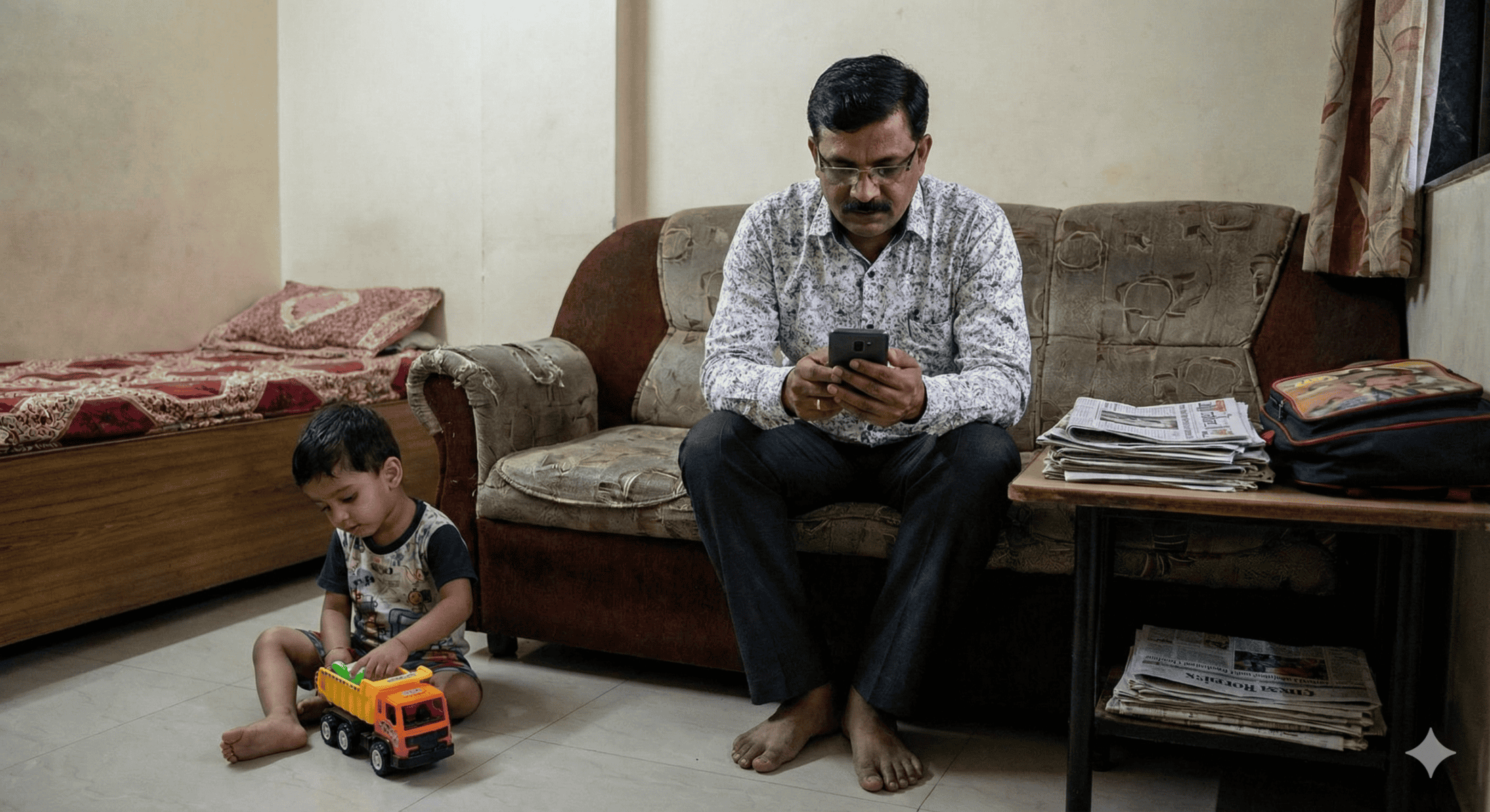
One provides resources. The other lives inside his family’s nervous system.
Most fathers believe providing is enough.
And in a world moving this fast — technology upgrading, careers demanding more, life accelerating beyond our ability to reflect — that belief isn’t just common. It’s comfortable. You earn, you deliver, you solve the material problems. You check the box. Good father.
I believed it too. For a long time.
Until the day I realized that a good father and a present father are not the same thing. They’re not even close.
A good father provides. He is the one you turn to when there is a need for money, resources, decisions. He keeps the structure standing. He is reliable in the way that systems are reliable — functional, consistent, and transactional.
But a present father does something entirely different.
A present father lives inside the nervous system of his children. He is not just someone who shows up. He is someone whose presence stays — even when he’s not in the room. His words linger. The way he lives his life, the way he adapts, the way he handles pressure and failure and ordinary Tuesdays — all of it becomes testimony. A living reference his children carry with them long after they leave the house.
This is the difference no one talks about: a good father is remembered for what he gave. A present father is felt in how his family breathes.
Think about what happens in a home where a present father exists.
When the family thinks about this man, they feel calm. Not because there are no problems — there are always problems — but because they know there is someone who will hold the situation without losing himself inside it. There is a method. A steadiness. A way of approaching difficulty that the family absorbs and begins to replicate on their own.
And here’s the part that struck me the most: the family doesn’t become dependent on him. They become capable because of him. They resolve things themselves — and they credit him for it. Not because he solved it for them, but because his presence, his availability, his way of being taught them how.
That kind of influence doesn’t come from providing. It comes from proximity. From being there — emotionally, not just physically.
A present father knows something that a provider often misses.
When his children go out to take on a challenge, he already knows they might need him at some point. And he quietly knows what the problem might be before they even call. Not because he is controlling. Because he is attuned.
And when they do call — and this is the part that changes everything — there is no judgment.
No accusation. No interrogation about what went wrong. No making the child feel smaller than the problem they’re already carrying.
There is just trust. Emotional safety. The unspoken knowledge that you can bring anything to this man and he will not use it against you.
This is what I mean by living inside the nervous system. The child doesn’t just know intellectually that their father will help. They feel it in their body. There is no tightness before dialing the number. No rehearsing what to say. No bracing for disappointment.
Just the quiet certainty: I can go to him. And I will be safe there.
Here is where a provider and a present father diverge most sharply.
A provider gives something — so naturally, he expects accountability in return. It’s transactional. I gave you this, so you owe me that. The ledger must balance. And when a child makes a mistake, the provider’s first instinct is to hold them accountable. Immediately. The lesson comes at the moment of crisis, when the child is most vulnerable and least able to absorb it.
A present father operates differently.
He knows accountability matters. He is not soft on standards. But he understands sequence. Safety comes first. Trust stays valid. The problem gets resolved — together, like a team. And only after the storm has passed, only after the child is steady again, does the conversation about what happened and why take place.
The lesson follows the resolution. Not the other way around.
This is not permissiveness. This is emotional intelligence in action. The child learns the same lesson — perhaps even more deeply — because they received it in a state of safety rather than a state of shame.
This is the distinction I wish someone had drawn for me earlier.
You can be a good father and still have children who are afraid to call you. You can provide everything and still raise a home where people perform instead of belong. You can check every box and still be absent in the only way that matters — emotionally.
A present father doesn’t just fill the room. He fills the nervous system. He becomes the voice his children hear when they’re alone and afraid — not a voice of judgment, but a voice of steadiness. A voice that says: We’ll figure this out. You first. The lesson later.
That shift — from accountability first to safety first — is the difference between a home that functions and a home that heals.
I’m still learning this. Every day.
Still catching the provider instinct — the reflex to correct before connecting, to teach before holding, to measure before being present.
But I know the difference now. And once you see it, you can’t unsee it.
Being a good father is about what you give. Being a present father is about who you are when they need you most.
One fills the fridge. The other fills the room.
And your children — they know the difference. Even if they never have the words for it.
— Santosh Acharya