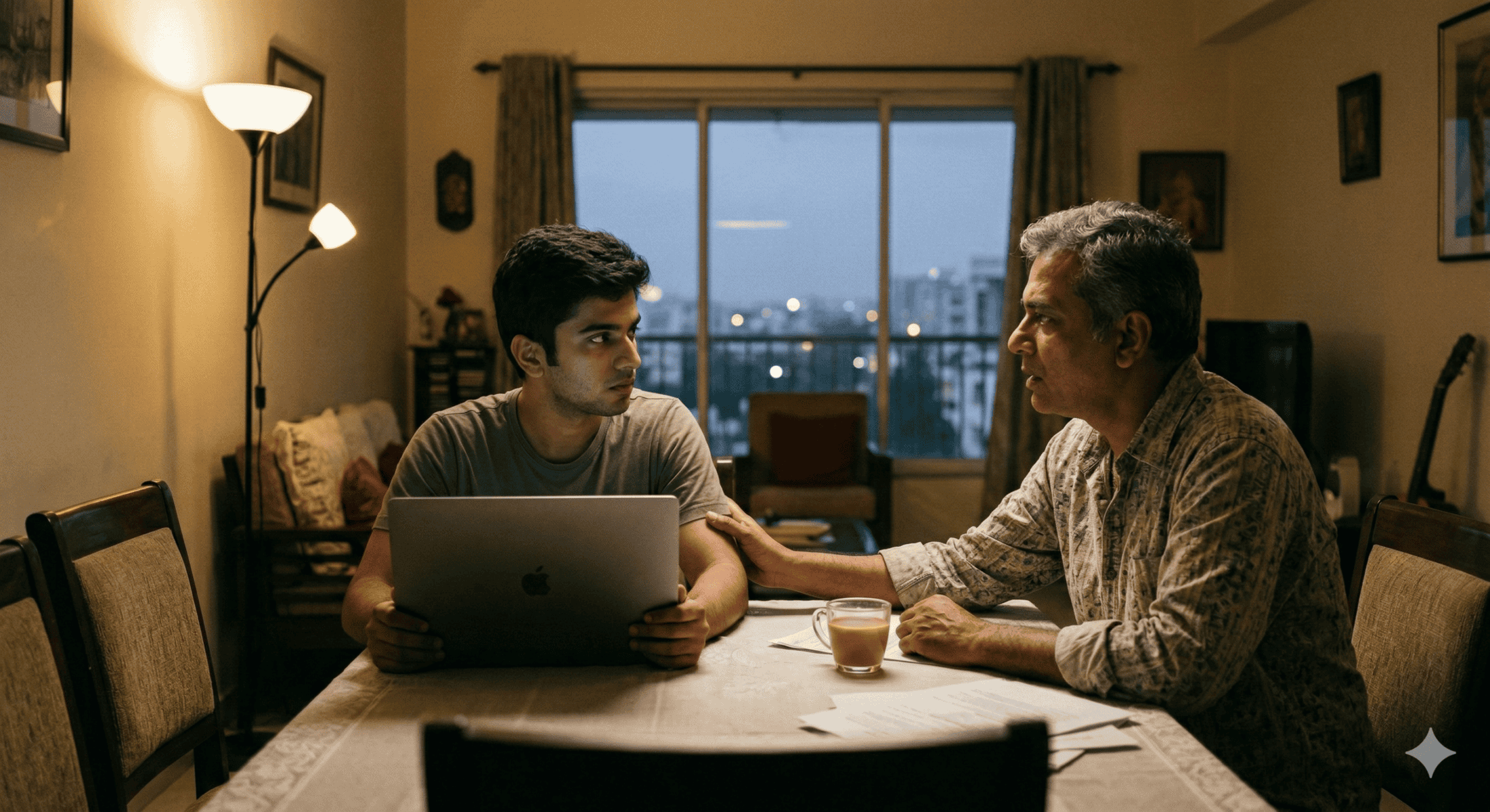
It was past midnight.
My son and I were shouting at each other — two voices filling the house in the dark — until I couldn’t hold it anymore and screamed: “Stop!”
The room went silent.
And the night ended there. Not resolved. Not repaired. Just… stopped.
It had started innocently enough.
Two days after my birthday, he came to me and began asking questions. About my health. About whether I was taking care of myself. About what I was doing — or not doing — for my body.
The questions started gently. And I started answering.
But as the conversation moved, I felt something shift inside me. These weren’t casual questions. They were targeted. Concerned. Persistent.
And then it happened — a flash of something in my nervous system that I didn’t expect.
I looked at my son and I saw my father.
Not literally. Not visually. But in the pattern of the conversation — the way the questions were coming, rapid, relentless, laden with expectation — my nervous system did what nervous systems do when they recognise danger.
It collapsed time.
It pulled me twenty, thirty years back — to a boy sitting in front of a man who asked questions that weren’t really questions. Questions that were measurements. Questions that meant: you are not enough yet.
And suddenly I wasn’t a father having a conversation with his son about health.
I was a child being interrogated by my father.
My throat stiffened. My heart rate climbed. A cold mix of fear and defensiveness rose in my chest — the particular feeling of being a victim who has to explain himself. Who has to justify. Who is, somehow, already wrong before he opens his mouth.
I told my son: “I don’t want you to be my father.”
It came out harder than I intended. And the moment it landed, something cracked open between us.
He raised his voice. I raised mine. What started as concern became combat. What started as love became noise.
I wasn’t fighting my son that night.
I was fighting a ghost.
But my son didn’t know that. He only knew that he came to me worried about losing me — and I responded like he had attacked me.
That night, I couldn’t sleep.
The conversation replayed itself — all the loose ends, all the moments I could have chosen differently. The places where I could have paused. Where I could have said: “I hear you. You’re worried about me. That means something.”
Instead I had heard my father’s voice in my son’s concern — and I had reacted to the ghost, not the boy in front of me.
This is what unprocessed history does. It doesn’t stay in the past. It arrives at the most intimate moments, wearing the faces of the people you love most, and hijacks the present.
I had spent years building the father I wanted to be. Regulated. Present. Safe. And in one midnight conversation, the old wiring had run the show — not because I was a bad father, but because the trigger was precise. Because the one thing I never expected was that my son’s love would feel like my father’s control.
I had confused care for surveillance. Concern for interrogation. And I had paid for it with the one thing I had worked hardest to protect: his trust.
The next morning, I went to him.
I didn’t have a plan. I didn’t have promises I was certain I could keep. I had one thing: honesty.
I said sorry for the way I responded. Sorry for being harsh. Sorry for letting the night end the way it did.
And I told him I would look at what I could do for my health. That I would come up with a plan. It wasn’t grand. But it was real — and he could tell the difference.
He looked at me for a moment.
Then he said sorry too.
And I said okay.
That was it. No long discussion. No post-mortem of every word. Just two people — a father and a son — choosing each other again after a night of losing each other.
The repair was small. But what it meant was not small.
Because repair is never really about the argument. It’s about what comes after. It’s about whether you go back. Whether you say the thing that costs you something. Whether you show your child: even when I lose myself, I will find my way back to you.
What I understand now, that I couldn’t see that night, is this:
My son’s questions came from love. Pure, worried, protective love. The love of a young man who has started to see his father not just as a parent, but as a person — someone with a body that can wear out, a man who needs looking after too.
That’s not a small thing.
That’s the reversal every father hopes for and rarely notices when it arrives — the moment your child begins to love you back, not just from need, but from choice.
And I almost turned it into a wound.
If you’re a father reading this, I want to sit beside you in this specific truth:
Your past will show up in your parenting. Not because you invited it. Because the nervous system doesn’t distinguish between then and now when the pattern feels the same.
The work is not to be someone who never gets triggered. That’s not a father. That’s a performance.
The work is to be someone who goes back. Who repairs without drama. Who says sorry without making the apology about himself.
And who, the next time his son asks him a hard question out of love, can stay in the room long enough to hear it for what it actually is.
Not surveillance.
Not control.
Not his father’s voice.
Just a son.
Worried.
Watching.
Hoping you’ll be okay.
— Santosh Acharya