How unconscious emotional patterns shape families more than intentions ever will.
We don’t fail our families because we don’t love them.
We fail them because we were never taught how to lead emotionally.
What follows is not a theory—
it is a mirror.
A Thought That Refused to Die
There is a piece of writing that has quietly traveled across decades…
copied, forwarded, reposted, and remembered.Often attributed to Bob Moorehead,
“The Paradox of Our Time” has appeared on countless corners of the internet—
from reflective blogs like Appleseeds
to personal archives such as Martin Summerhayes Blog,
and reposted across spaces like Bytes Daily Blog and The Divine Nature Blog.Not because it was optimized.
Not because it was marketed.But because it felt… true.
It named a contradiction we were all living—
but didn’t know how to articulate.And yet…
while it spoke about society, progress, and modern life—
it left something deeper, more intimate… unexplored.Not the world outside us—
but the world within our homes.Not systems—
but relationships.Not time—
but emotional inheritance.Because the real paradox is not just out there.
It is sitting quietly…
in our living rooms.
—
The Family Paradox
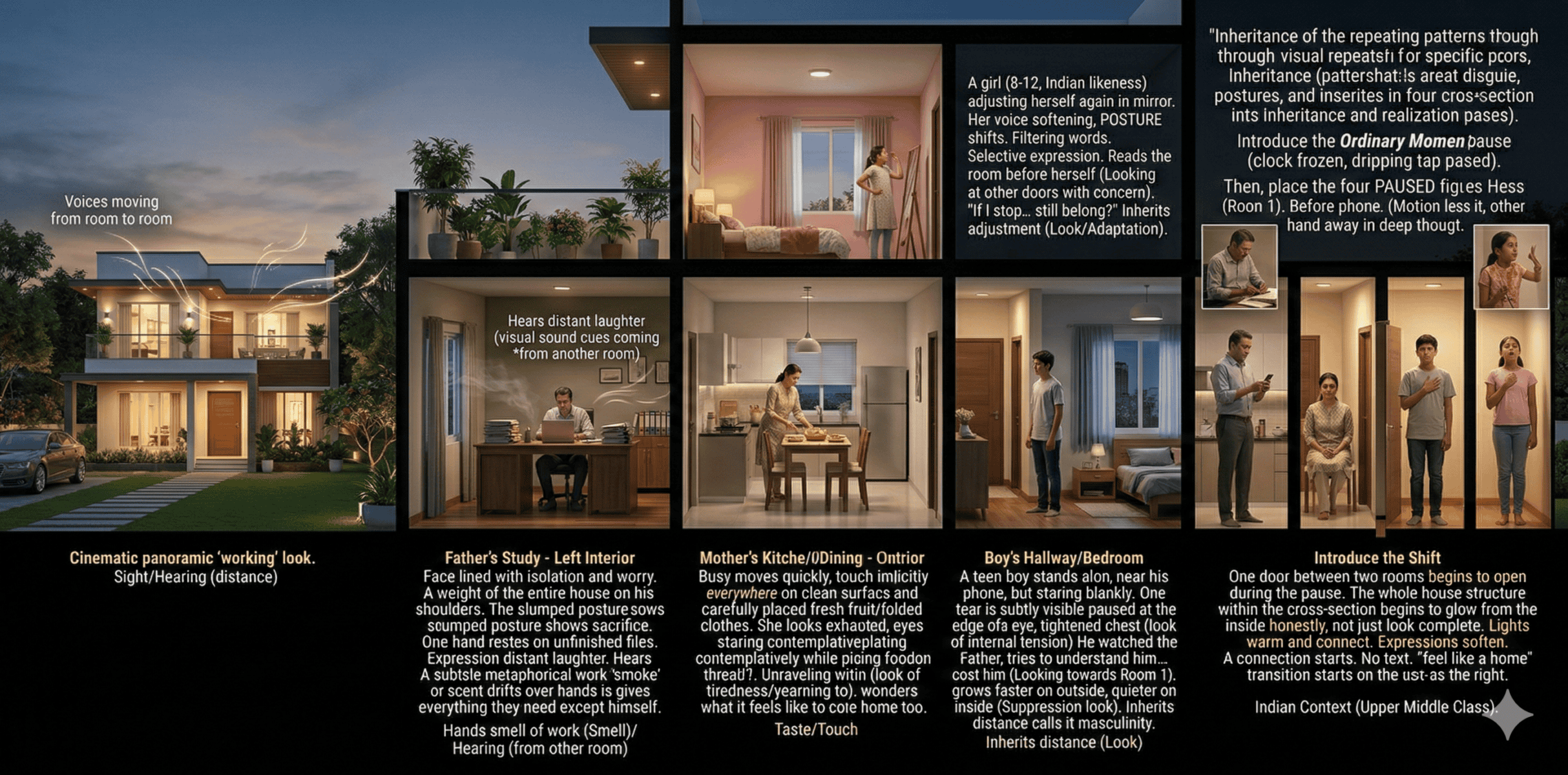
There is a house that looks complete from the outside.
Lights on.
Doors intact.
Voices moving from room to room.
If you stand at a distance…
it looks like everything is working.
But step closer—
and listen.
Not to what is being said…
but to what is being carried.
The Father
In one room—
a man sits with the weight of the entire house on his shoulders.
He has built these walls with time, with effort, with sacrifice—
and still…
they do not echo with his presence the way he imagined.
His hands smell of work.
His mind tastes of unfinished responsibilities.
He hears laughter from the other room—
bright, alive—
and feels a strange distance…
from the very life he is sustaining.
He gives them everything they need—
except the one thing
they cannot ask for directly.
Him.
The Mother
In another room—
a woman moves quietly,
filling spaces before they are noticed empty.
Her touch is everywhere—
in the food,
in the folded clothes,
in the softened conflicts—
and yet…
there is no place
where she fully rests.
She holds everyone together—
like invisible thread—
and slowly…
unravels within herself.
She is the emotional home for all—
but somewhere deep inside…
she wonders
what it feels like
to come home too.
The Boy
Down the hallway—
a boy learns the rules without anyone writing them down.
His tears pause at the edge of his eyes—
not because they disappeared…
but because they are no longer welcome.
His chest tightens before his voice can break.
He is learning strength—
but what he is really learning
is how to disappear from his own feelings.
He watches the man in the other room—
tries to understand him…
become him…
without ever knowing
what it cost him.
So he grows—
faster on the outside,
quieter on the inside—
becoming someone
the world will respect…
but he may never fully know.
The Girl
And somewhere near the window—
a girl adjusts herself…
again.
Her voice softens.
Her posture shifts.
Her words filter themselves
before they are spoken.
She is learning how to be loved—
by becoming easier to love.
She reads the room
before she reads herself.
She gives more,
asks less,
feels deeply—
but shows selectively.
And somewhere within her—
a question forms quietly:
“If I stop adjusting…
will I still belong?”
The House
And so the house continues—
full of movement,
full of roles,
full of effort—
The father provides.
The mother holds.
The boy suppresses.
The girl adapts.
Everything works.
And yet—
something feels…
unfelt.
Conversations happen—
but truths remain untouched.
Love exists—
but is not always experienced.
Presence is there—
but connection… flickers.
No one is wrong.
No one is failing.
And still…
something keeps repeating.
The Inheritance
Not through words—
but through patterns.
The father passes down silence
disguised as strength.
The mother passes down sacrifice
disguised as love.
The boy inherits distance
and calls it masculinity.
The girl inherits adjustment
and calls it identity.
And the house—
stays standing.
But something inside it…
goes unspoken
for generations.
The Realization
And then—
sometimes—
in the middle of an ordinary moment—
a pause appears.
Too small to notice.
Too important to ignore.
A father hesitates… before looking at his phone.
A mother sits… a second longer than usual.
A boy feels something… and doesn’t push it away immediately.
A girl thinks something… and almost says it out loud.
And in that pause—
something begins to shift.
Not loudly.
Not dramatically.
But honestly.
Because the truth is—
this was never about a broken family.
It was about an unaware one.
The Paradox
And this is the family paradox:
They love each other deeply—
but were never taught
how to let that love be felt.
They give everything they have—
but not always
what was needed most.
They stay together—
but sometimes…
live miles apart
within the same walls.
And the deepest truth—
the one that changes everything—
is this:
Nothing here
needs more effort.
It needs… awareness.
Because the moment someone sees this—
not as blame…
but as truth—
the pattern can end.
Not perfectly.
Not instantly.
But consciously.
And maybe…
for the first time—
this house
will not just look like a home
from the outside—
it will begin to feel like one
from within.
—
If you saw yourself in this… good.
Not because something is wrong with you—
but because something has finally become visible.
Emotional leadership begins here:
not in changing others…
but in seeing clearly what we have been repeating unconsciously.