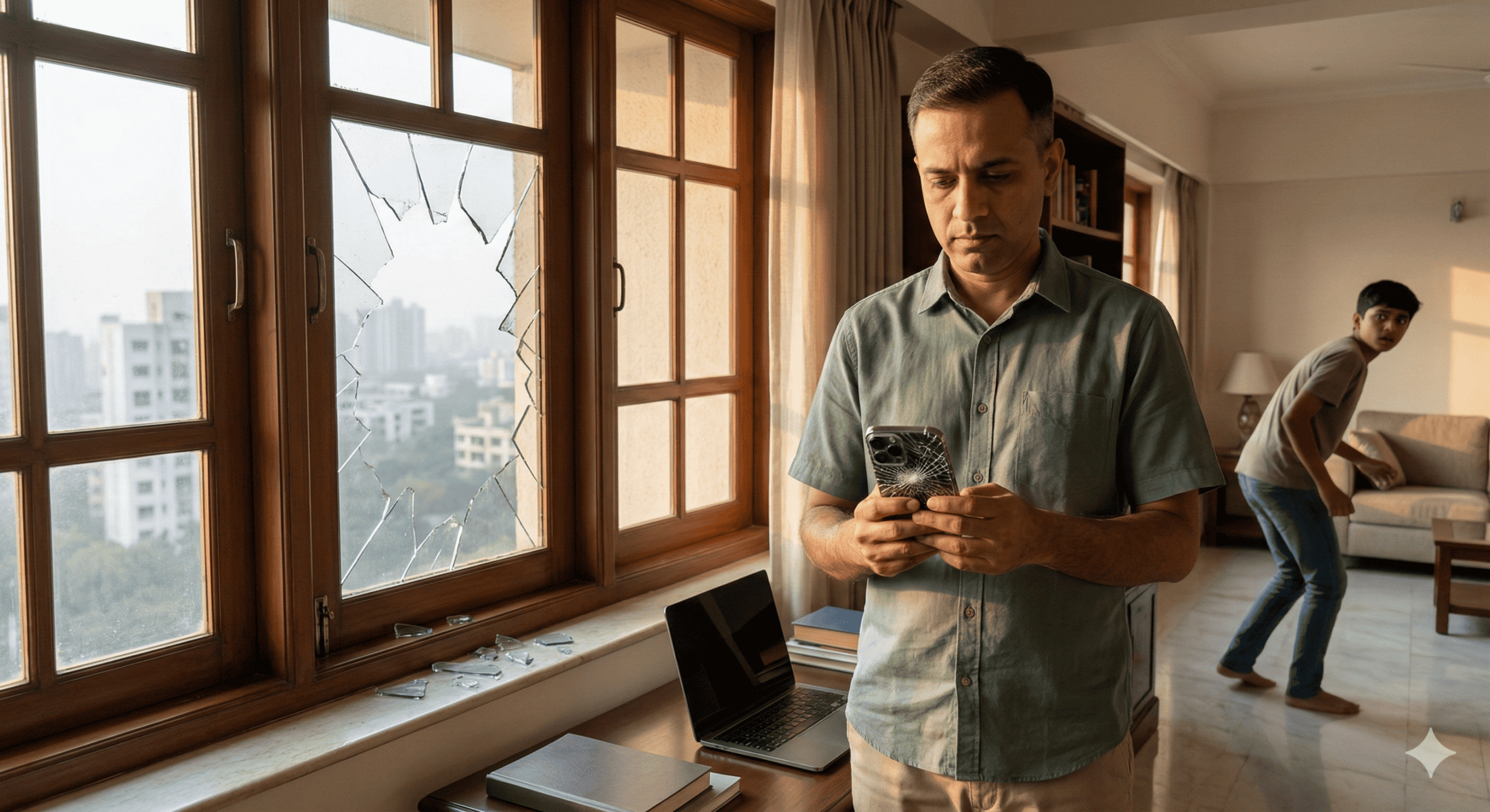
I walked into the house and saw my son’s body before I saw the damage.
He was standing there—fourteen, tall enough to look like a young man—but shrinking like a small child. His shoulders were curled inward. His eyes were wide and wet, like he was holding back tears. His face had too many emotions at once: anger, fear, shame, panic.
And in that second I realised something that hit me harder than any broken object in the room:
My child was afraid of me.
My wife had called me before I reached home. She told me the phone I bought just four days ago was broken. In anger, my son had thrown it, it hit the window, and the glass broke too.
We were a big family living together then—six or seven people in the same home. My parents were with us. My father’s sister was with us. There wasn’t much personal space, and my son was in that teenage phase where even small limitations feel like a cage.
He had been angry for months. Angry about what we couldn’t do for him, angry about the lack of space, angry in the way teenagers get angry when they don’t yet know how to carry their own intensity.
When I got the call, I expected myself to be furious.
But by the time I reached home, my anger had already cooled into something else: curiosity. What made him explode like this? What is he carrying?
I entered calm. No shouting. No storm.
And still—he looked at me like a storm had arrived.
That’s the part I had not understood about fatherhood until that day.
Even when a father is quiet, the child can still be terrified—because fear is not only about what is happening now. It’s also about what has happened before, what the child expects, what the child has learned to prepare for.
My wife showed me the broken phone and the broken window.
And I won’t pretend I felt nothing.
I had spent around twenty thousand rupees on that phone four days earlier. When I saw it, a sharp pain moved through my body. My throat tightened. Something pressed in my chest. My shoulders felt heavy, like they were carrying the weight of responsibility, money, effort… and now loss.
In that moment, I could feel a different version of me trying to rise.
The version that says: This is unacceptable. The version that believes anger is how you restore order. The version that thinks fear in a child equals respect.
But another thought cut through all of that:
If I explode now, I may win the moment… and lose my son.
So I paused.
Not a dramatic pause. A simple one. One breath. One decision.
I looked at my wife and said, calmly, “This mobile can be repaired. And even the window can be repaired.”
Then I called my son closer—not to corner him, but to bring him back into connection.
And I made a small dad joke: “You should have broken my old mobile. I would have bought a new one for myself.”
I saw the room change.
It wasn’t magic. It was nervous system physics. The tension dropped. My wife relaxed. And my son—most importantly—stopped shrinking. His face softened. His breathing became more normal. For the first time since I walked in, he looked like he was coming back from the edge.
Then I told him, “When you are okay, I want you to come and tell me what happened. Why this happened.”
I didn’t demand a confession. I didn’t interrogate him while he was flooded. I left him a door instead of a wall.
Later, when I sat with myself, I realised the deepest truth in that moment wasn’t about parenting technique.
It was about value.
There will be losses in a home—money, objects, things that break. But sometimes the most precious thing in front of you is not what got damaged.
It’s the person who is standing there, terrified, waiting to find out whether love is predictable… or conditional.
That day, I saw clearly: the phone had a price.
But my son had a life.
And if I taught him that his mistakes make him unsafe with me, he would stop bringing me his truth. He would stop bringing me his fear. He would stop bringing me himself.
So I chose him.
Not by ignoring what happened. Not by pretending it didn’t matter. But by deciding that repairing the relationship mattered more than punishing the moment.
I’m sharing this because I know how many fathers carry a quiet belief: “If I don’t show anger, my child won’t learn.”
But what I’ve come to believe is simpler—and harder:
A child doesn’t learn emotional strength from our intensity. He learns it from our steadiness.
If you’ve ever seen fear in your child’s eyes because of you, you don’t need more guilt. You need a new standard to hold yourself to.
Objects can be replaced.
Trust is slower.
And the day you notice your child is afraid of you can become the day you decide: fear will not be the glue that holds my family together.
It will be safety.
It will be presence.
It will be repair.